
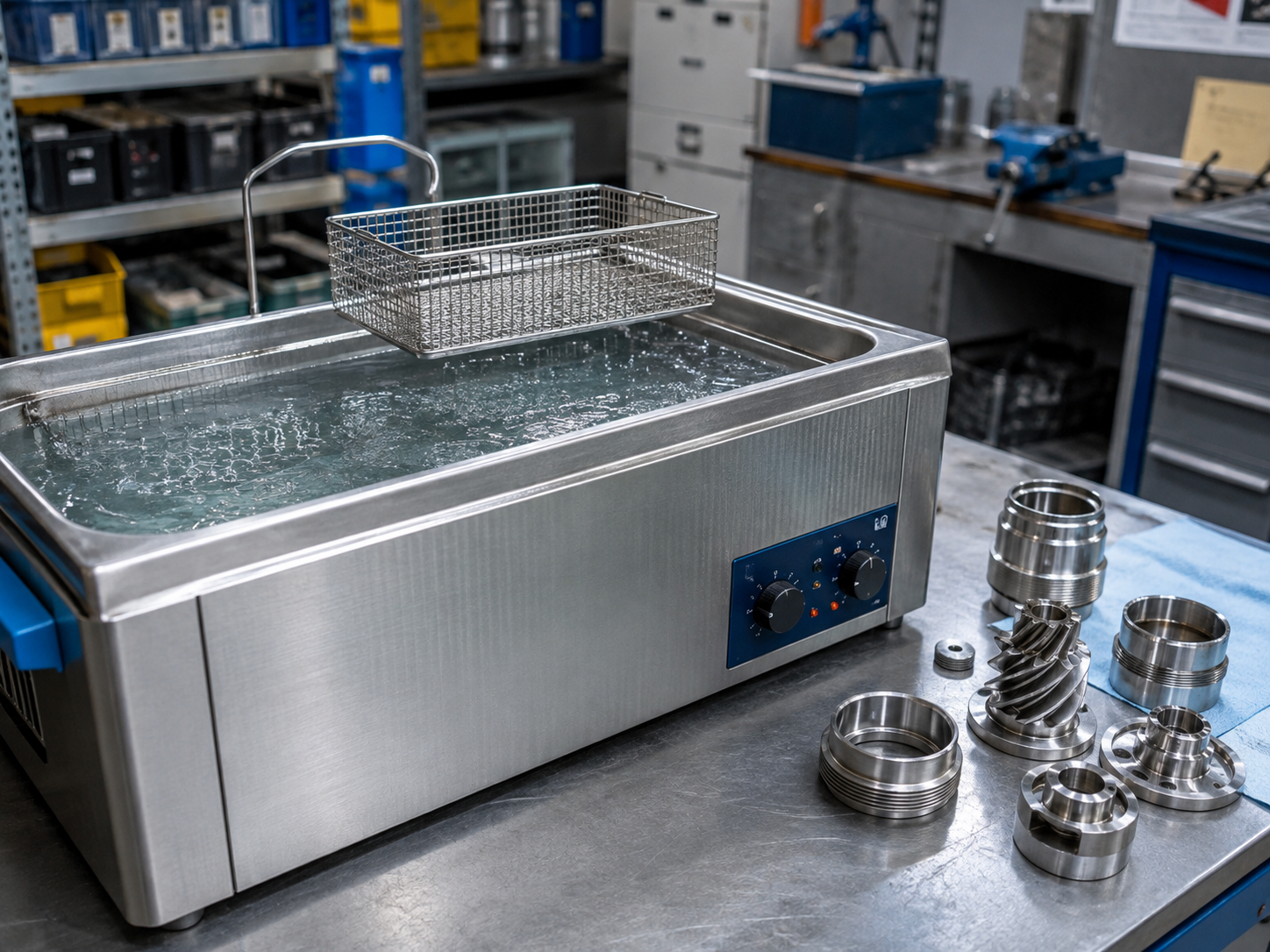
Ultrasonic Cleaning | Precision Part Cleaning
Deep, non-abrasive cleaning for metals, polymers, and complex components using advanced ultrasonic technology for unmatched detail and consistency.

Ultrasonic Cleaning
Deep cleaning that reaches where hand methods don’t.
-
Ultrasonic Cleaning - What is it?
Ultrasonic cleaning is an advanced, non-abrasive process that uses high-frequency sound waves and specialized cleaning solutions to remove contaminants from virtually any surface. When parts are immersed in the ultrasonic tank, microscopic bubbles form and collapse through a process called cavitation, safely dislodging oils, carbon buildup, rust, powder coating residue, and other contaminants from even the most complex surfaces.
This method delivers precision cleaning that traditional scrubbing, solvents, or blasting cannot achieve. It’s ideal for restoring and maintaining performance-critical parts in industries such as automotive, aerospace, manufacturing, medical, firearms, and tooling. Whether you’re cleaning small intricate components, restoring metal finishes, or prepping parts for coating, ultrasonic cleaning provides a fast, consistent, and environmentally conscious solution.
At PrimeCore Precision, our ultrasonic systems are tuned for deep penetration and uniform results, ensuring every component leaves fully cleaned, residue-free, and ready for final assembly or finishing.
-
Ultrasonic Cleaning - How does it work?
Ultrasonic cleaning relies on high-frequency sound waves that travel through a liquid medium to create microscopic bubbles. These bubbles rapidly form and collapse in a process called cavitation, generating localized pressure changes that lift away contaminants from the surface of a part. Because the bubbles reach into fine details, threads, and internal passages, even the most intricate components come out completely clean without manual scrubbing.
The parts are placed in a tank filled with a specialized cleaning solution that enhances the cavitation effect. Once the ultrasonic energy is introduced, millions of these microbubbles continuously implode, loosening and carrying away residues. The process works quickly, evenly, and safely across a wide range of materials, ensuring a true precision clean from the inside out.
-
Is it right for my application?
Ultrasonic cleaning is the right choice when precision, consistency, and access matter. It reaches deep into tight areas that hands, brushes, or traditional tools simply can’t clean efficiently. Internal passages, blind holes, threads, vents, and fine surface textures are all areas where ultrasonic energy excels.
This process is highly effective for removing baked-on carbon, grease, polishing compound, cutting fluid, rust, powder coating residue, and other embedded contaminants without damaging the surface. It’s used extensively for engine parts, tooling, injection molds, firearm slides and components, aerospace assemblies, and high-performance automotive or industrial equipment.
If your application involves cleaning complex parts that require attention beyond what manual methods or spray systems can achieve, ultrasonic cleaning provides the precision and depth needed to restore performance and appearance with unmatched efficiency.
-
Get a Quote / Request a Test Clean
If you are looking to restore or maintain precision parts, our team can provide a quote based on part type, material, and contamination level. PrimeCore Precision offers professional ultrasonic cleaning for everything from single components to full production batches.
For batch services, we also provide test cleaning to confirm results and process suitability before full-scale work begins. Each project is evaluated individually to determine the correct cleaning chemistry, temperature, and cycle time for the desired finish.
Submit your part details or photos below to receive a quote or schedule a test cleaning for qualifying batch services. Our team will review your information and respond promptly with pricing and next steps.
PrimeCore Precision provides professional ultrasonic cleaning services in Warren, Michigan, supporting manufacturers, contractors, and industrial clients throughout Metro Detroit including Sterling Heights, Troy, Madison Heights, Fraser, Roseville, Center Line, and surrounding areas. Operating from an industrial facility, we specialize in precision cleaning for parts, tools, fixtures, and components where residue, contamination, or buildup cannot be addressed through conventional methods. Local clients benefit from responsive communication, controlled processes, and reliable turnaround for both one time projects and repeat service requirements.
Ultrasonic cleaning is an effective solution for removing oils, carbon buildup, polishing compounds, machining residue, and embedded contaminants from complex parts and assemblies. High frequency sound waves create microscopic cavitation bubbles within the cleaning solution, allowing contaminants to be lifted from surfaces, blind holes, threads, internal passages, and intricate geometries that cannot be accessed through manual or abrasive methods. This process ensures uniform cleaning without altering dimensions or damaging sensitive features.
Ultrasonic Cleaning Contact Form
Ultrasonic cleaning is available for individual components, mechanical parts, firearm parts, tools, and production quantities. For industrial or recurring work, include approximate quantity, material, contamination type, and any turnaround requirements.